News
Home > News
News
News

Plastic optical fiber: Illuminating the future path of short-distance communication

2024-07-08

A transparent fiber with a diameter of only1mm is quietly and efficiently reshaping the connectivity pattern of automobiles, industrial control, and home communication.

With the continuous development of optical communication technology, in addition to the quartz glass fiber we are familiar with, there is also a kind of fiber product based on polymer materials, which is designed for short-distance transmission and is gradually recognized by the market——plastic optical fiber (POF, Plastic Optical Fiber).

As a new type of optical transmission medium with high flexibility, low weight, and easy installation, plastic optical fiber has shown outstanding performance advantages in multiple application scenarios. From the information entertainment system of high-end cars to the automated data link in the industrial workshop, and from the precision light guide of medical equipment to the 8KHDvideo transmission of home theaters, it is replacing some traditional copper cable and quartz optical fiber solutions in a more cost-effective way.

With itslow cost, strong anti-electromagnetic interference ability, and wide adaptabilityand other characteristics, plastic optical fiber is gradually becoming an important technical option in the field of short-distance optical communication, leading a low-key but profound industrial revolution.

01 From Lab to Commercial Application: A Journey

The research on plastic optical fiber began in the1960s.In1968,

1974, the Japanese company Mitsubishi Rayon made an important breakthrough, developing plastic optical fibers withPMMA and polystyrene as the core material and fluor Plastics as the cladding, reducing optical loss to3500dB/km.

1990 was a critical node in the development of plastic optical fibers. Professor Kyoji Koshino at Keio University in Japan successfully developed a gradient index (GI) plastic optical fiber with a fluorine-containingPMMA core, manufactured using interfacial gel technology. The attenuation of this fiber was controlled below60dB/km, with a bandwidth of3GHz, and a transmission rate of up to10Gb/s. The performance even exceeded that of the then existingGI type quartz optical fibers.

After entering21 century, the technology of plastic optical fiber continues to advance.In2000 year, theASAHI GLASS company in Japan reported that the fluorine gradient plastic optical fiber has aattenuation coefficientof41dB/kmat a wavelength of850nm, and only33dB/km


02 Materials and Structures, diverse design options

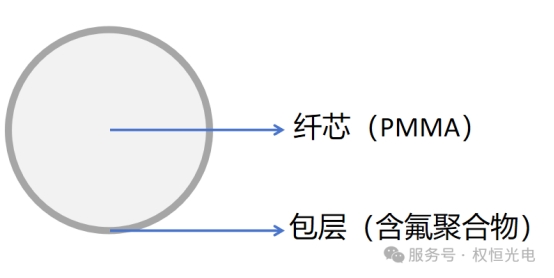
Plastic optical fiber is an optical fiber made of polymer materials, usually with polymethyl methacrylate (PMMA) as the core material, and the cladding is made of low refractive index polymers such as fluorine-containing polymers. Different materials have different light attenuation characteristics and temperature application ranges.


PMMA plastic optical fiber has a loss of about 180 dB/km in the visible light band (650nm), suitable for 10-100 meter transmission, commonly found in smart home and consumer electronics fields. Fluorine-containing polymer optical fiber performs excellently in the near-infrared band (850-1300nm), with a loss reduced to 10-50 dB/km, extending the transmission distance to 500 meters.

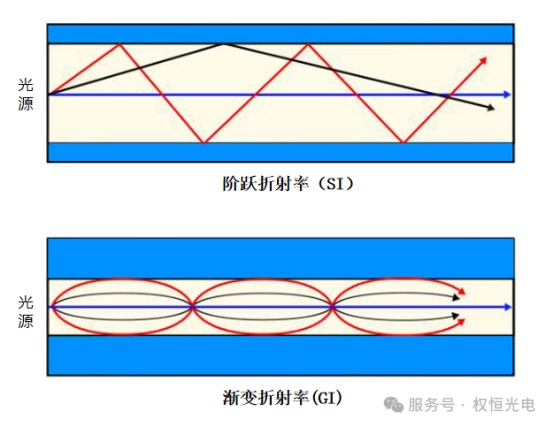
From a structural perspective, plastic optical fibers are mainly divided into two categories: step-index (SI-POF) and gradient-index (GI-POF).


SI-POFhas a refractive index sudden change at the core-cladding interface, and the light signal is transmitted through. This structure is low-cost to manufacture, but has a low bandwidth (about5MHz·km), suitable for low-speed short-distance scenarios, such as lighting decoration and simple sensors.

GI-POFhas a gradually decreasing core refractive index from the center to the outside, and the optical signal is transmitted in aparabolic轨迹. Its bandwidth can reach1-10GHz·km, supporting gigabit-level data transmission, and is often used in high-speed application scenarios such as vehicle networks and industrial automation.

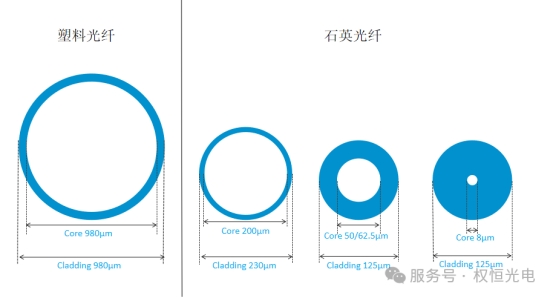
The core diameter of plastic optical fiber is usually larger, generally in the range of200to1000μm, which is several times or even tens of times larger than that of conventional quartz multimode optical fiber. Due to thelarge core带来的 larger numerical aperture, even if there is an alignment deviation of±30μmin the process of connection, it will not significantly affect the coupling efficiency. This high fault tolerance greatly simplifies the fiber connection process and reduces the construction complexity.


03Performance advantage, disruptor in specific scenarios 

Polymer optical fibers (POFs) have shown versatile and significant advantages in short-distance communication applications. Among them, low cost is one of its core competencies. POFs can be produced through mature polymer drawing processes, which are simple in process and have low energy consumption, significantly reducing manufacturing costs, making them particularly suitable for large-scale application scenarios.

In terms of mechanical properties, plastic optical fibers possess柔软而坚韧 characteristics. Even with a diameter exceeding1mm, they maintain excellent flexibility and bending resistance, meeting the demands for complex cabling in confined spaces. In contrast, quartz fibers only exhibit a certain degree of flexibility at small diameters and typically require additional plastic coating to enhance durability.

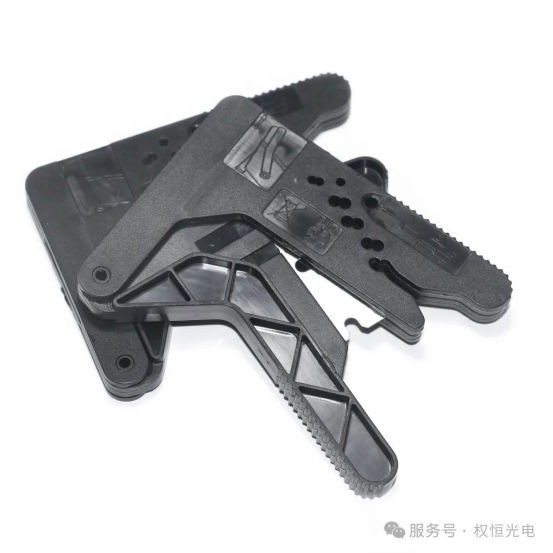
In terms of connection operations, plastic optical fibers also possess显著 simplicity. Its polymer core can be quickly terminated using conventional cutting tools (such as dedicated cutters) without the need for splicing equipment or endface grinding processes. The entire connection preparation process can usually be completed within1 minute, significantly reducing the threshold for installation and the cost of system deployment, especially suitable for field construction and operations by primary users.


Moreover, plastic optical fiberexhibits significantly superiorEMIresistance compared to traditional copper cables. In complex electromagnetic environments such as automotive electronics and industrial automation, its interference resistance can be over a thousand times higher than that of copper cables (the exact figure depends on the actual frequency and environmental conditions), ensuring higher stability and reliability for critical control and signal transmission.

In terms of ease of use, plastic fiber optic transceivers typically operate at650nmred light wavelength, which has visual characteristics that allow users to intuitively judge the connection status. At the same time, this type of fiber is less sensitive to dust and debris on the end face, and has good environmental adaptability, especially suitable for harsh working conditions such as dust and vibration.


04Application scenarios, transformer of multiple fields 

Automotive electronics: anti-interferenceneural network


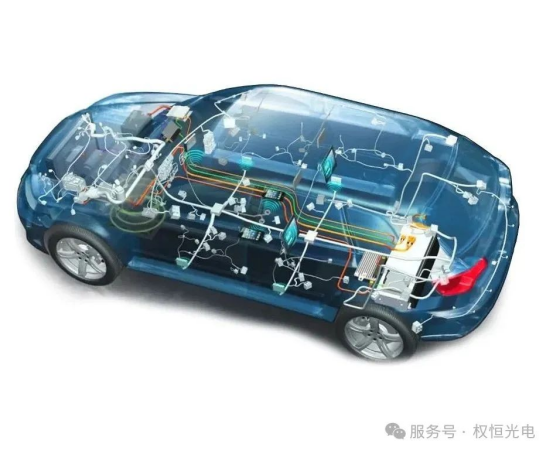
In modern automotive electronic systems, plastic optical fiber has become the ideal medium for in-vehicle network communication. Taking luxury models as an example, several kilometers of copper cables are usually laid inside the car. Plastic optical fiber, with its lightweight and high flexibility, can effectively reduce the overall weight of the vehicle, lower wiring costs, and enhance anti-interference capabilities.

Polymer optical fiber hasexcellent electromagnetic interference resistance (EMI) and excellent flexibility performance, its minimum bending radius can reach5mm, which can flexibly adapt to the narrow and tortuous space structure in the car, and is resistant to oil stains, high temperature, and has strong adaptability. Typical applications includein-vehicle Ethernet (1Gbps), reversing radar, in-vehicle information and entertainment systems, etc.

With the development of electric vehicles and autonomous driving technology, plastic optical fiber will continue to expand its application inAdvanced Driver Assistance Systems (ADAS),sensor signal transmissionandin-vehicle multimedia interconnection.


Industrial control: stabilizer in harsh environments


In the field of industrial automation and intelligent manufacturing, plastic optical fiber has become a reliable alternative to traditional copper cables, thanks to its excellent mechanical properties and environmental adaptability. Its operating temperature range can reach from -40℃ to 85℃, and it can operate stably for a long time under harsh working conditions such as high vibration, dust, oil stains, and chemical corrosion. In typical applications such as factory robot joint control, oil pipeline monitoring, and power isolation transmission, plastic optical fiber not only achieves electrical isolation but also has excellent anti-interference and data transmission stability. 

In addition, the plastic optical fiber system can be seamlessly integrated withprotocol convertersand standard interfaces such asRS232,RS422,100MbpsEthernet to meet the communication needs of various industrial field buses and control networks.


Medical equipment: safe and precise optical guide assistant


The medical industry's requirements for fiber materials include not only performance but alsobiological safety and ease of operation. Plastic fiber, with itsnon-toxic, flexible, safe, and easy to use properties, is widely used in various medical optical devices.

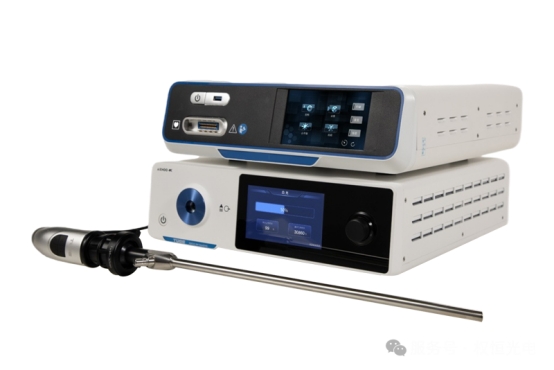
Its commonly used650nmred light bandhas good tissue penetration and visual recognition, which facilitates precise control of the energy transmission path and effectively assists doctors in judging the treatment area. Application scenarios include:endoscopic fiber delivery system,laser surgical instruments,minimally invasive fiber probesand so on.

As medical equipment becomes miniaturized and refined, plastic optical fibers will play an increasingly important role in surgical visualization, precision lighting, and energy transmission and other aspects.


Smart home: invisible information artery


In smart home and home network wiring systems, plastic optical fiber has become an ideal solution due to itseconomical, concealed, and low-interference characteristics. The fiber, with a diameter of only about1mm, can be flexibly embedded in wall cracks, baseboards, or decorative panels without occupying space, with concealed wiring, andno electromagnetic radiation, making it more secure. Compared with traditional copper cables, the wiring cost of plastic optical fiber can be reduced by about30% in short-distance transmission. Applications includesmart lighting controlhome local area network interconnection, and other scenarios.

With the popularity of the Internet of Things devices and home automation systems, plastic optical fiber will play an increasingly important role in buildinga stable, high-bandwidth, and secure home information network.


05 Technical Challenges and Future Trends: The Road to Continuous Innovation

Despite the many advantages of plastic optical fiber in short-distance communication, its development still faces some technical challenges,the high transmission lossis one of the most critical issues. The traditional plastic optical fiber withPMMAas the core material has a theoretical minimum loss of about100dB/kmat the wavelength of 650nm, which still has a significant gap compared to the low loss characteristics of quartz optical fiber.

To reduce loss, international scientific research institutions have been exploring various paths since the1980年代. For example, thedeuteratedPMMAtechnology reduces loss to about20dB/km , while the fully fluorinated polymer materials that emerged in the1990年代 achieve better loss control, but they have not been widely commercialized due to their high manufacturing cost.

JapanNTTlab-developed multi-core fluorinePOF, achieving a single fiber capacity of up to1Tbps, a reserve technology for6Gcommunication.

Overall, there is still a broad space for optimization at the material, structural, and manufacturing process levels for plastic optical fibers. Reducing loss and improving transmission performance will be the key directions for future development. With the maturity of new polymer materials and the continuous innovation of fiber design schemes, plastic optical fibers are expected to play a more core role in the next generation of short-distance high-speed communication.


06 Conclusion, The Future Road of Short-Distance Communication

Plastic optical fiber, with itslarge-core multi-mode unique structural characteristics, brings a brand-new solution to the short-distance communication field. The high coupling tolerance of its millimeter-level core makes the connection method simpler and more reliable, while significantly reducing the system cost and installation difficulty, showing its irreplaceable value in industrial control, vehicle network, home communication and other application scenarios.

With the advancement of communication technology towards5Gand beyond6G, the demand for edge transmission and low-latency interconnect continues to grow. Plastic optical fiber (POF) is expected to play a more critical role in short-distance, high-speed interconnects if further breakthroughs can be achieved in transmission rate, stability, and loss control. Meanwhile, with the rapid development of smart sensors and edge computing, the potential applications of POF insmart manufacturing, environmental monitoring, building control, and medical devicesare becoming more widespread.

From cars to factories, from hospitals to homes, plastic optical fibers are quietly connecting this diverse and complex world with a soft, lightweight, and tough posture. Inthe era of the Internet of Things, this transparent polymer fiber is becoming the key channel for short-distance information flow.


Contact Phone

8619951088516

Address:Building A1,No.198,Wuzhou East Road, Hanjiang District,Yangzhou City, Jiangsu Province.

Email:Info@rspof.com

Tel/Whatsapp/Wechat:8619951088516

WeChat

© 2025 Yangzhou RSPOF Technology Co., Ltd.  All Rights Reserved.